Home of some experimental (and not so experimental) musical effects and electronic instruments. Most are one-offs but there will be small purchasable batches available from time to time.
Found the time to (mostly) finish the new prototype this weekend. What's left to be done is ironing out the few glitches and adding a couple modes in software. Specifically:
-menu to assign a function to the soft-stomp. between tap tempo, shape record and manually triggered envelope
-a mode where it samples and makes an lfo/envelope based on input sound. could be pretty rad for drum machine stuff!
-I should probably make an option to invert whatever shape
...oh yeah, and definitely what's my densest/most insane PCB layout. It'll take a few weeks to arrive, though.
..though a bunch of it was copy pasted. I figure I'm about 95% done the new hollow earth, at least programming-wise. Hardware-wise, an AVR dev board, a few rotary encoders, a trimpot, an led and a 5x7 led matrix is all I've been staring at these past few weeks.
Four knobs is probably all you'll need! They're all multi-function. Turn for one thing, hold down and turn for another, tap for another, etc.
A bit of tech info. I'm using an atmega644 uC. It's got 64KB program memory but so far I'm using only 17% of it. I needed the 2KB of eeprom it offered for preset storage. When recording custom LFO shapes, it samples at 10 a second for up to 18 seconds. And then it's interpolated times 20 to smooth it out. Speed is full adjustable while recording and after, obviously. 10sps is plenty for slow human hands, but I'll offer the user to fine tune this in a sort of "preferences" mode.
Let's see, checklist. What's done, and to-do..
(software) -expressive display -hook up PWM output (with freq doubling) -do custom LFO record/playback -x20 interpolation! -speed control -tap-tempo -depth control -random blend -preset saving/loading -square/triangle/ramp/sine/saw hard preset LFOs -shape edit -trigger mode -multimode tap footswitch -preferences/options
clicky encoders are annoying. ordered some non-clicky ones.
with the push-for-secondary-function knobs and the display now offering an expressive level of visual feedback, I've been able to simplify the next hollow earth pedal to just 4 push-knobs and one toggle at the back of the enclosure!
this was a huge priority because it means I can PCB mount everything on a single board this time!
So I got myself a couple tiny 5x7 LED matrix displays to tinker around with. I thought they might be a nice replacement to 7-segment displays. On the new Hollow Earth, I'm using a microcontroller with a greater number of pins, so I think it's doable. Might make for some neat animation, too!
Then my mind caved in at the thought of manually typing binary data for each PIXEL. It's pretty daunting to do by hand, because each LED in the matrix does NOT have its own pin. Instead it's a row and column array where you have to carefully "render" the LEDs, line by line, applying positive power to cathodes where you *don't* want pixels, and so on. Arrrrghhhhhhhhhhhhhhhhhh..........
Too much, I said, so what do I do? I install something I haven't used in like ten years, Visual Basic 4.0.
An hour later, I have made an app where I can draw a number, letter or graphic just by clicking on squares, and then automagically spits out code and/or raw binary data I can simply paste in my micro!
Whatta time saver!
Writing a program that writes code for you. How zen!
I've started a complete Hollow Earth redesign. I really want to see it being sold again and the old design was just so difficult. Being on two PCBs, socketed ribbon cables, wired switches, hacks and tricks giving each build it's own little quirks. I've had enough of all that. The old one was designed when I was just beginning to understand microcontrollers almost two years ago and I've learned a lot since. Time to do it right, this time.
Instead: -single PCB design -everything PCB mounted, except jacks -rotary encoders instead of pots, with double functions (turn does one thing, push and turn does another, or just push, like tapping the speed knob for tap tempo) -less parts (no "shape" stompswitch for one) -in-program interpolation, no more smooth knob -and so on
Probably no more vactrols either. They were a pain to bias properly so that CV-out and the actual tremolo effect played nicely together. Gonna try digital potentiometers instead.
UPDATE: I'm afraid trigger mode will probably go the way of the dodo. It never worked THAT great, and it's one of the major roadblocks in my simplifying.
I've finished a new website for my various musical projects (not really DIY-related). So now instead of pointing people to a myspace, I can just send them to this:
This is something I've been working on (on-and-off) since january or febuary of '10. For DIYers, looping is usually restricted to ISD sound recorder chips. They are neat but don't offer a whole lot of flexibility. I wanted totally random access to individual samples for some pseudo-granular drones so I saw what I could do with microcontrollers. Initially I had started learning dsPICs, but later put it aside and went with what I knew, the 8bit AVR.
I'm using SPI RAM which isn't the fastest solution but I just wanted to see if my ideas could be done. Fidelity was secondary. I went with the ATMEGA328 which is the chip with the most amount of internal RAM in DIP format. I didn't want to use the larger 40-pin DIPs.
I wanted to be able to ping-pong the "playback head" in as little time as a 1ms sample window, define start and end loop points, among other things. That meant quite a bit more code that simple record and playback. Keeping it tight, I still manage up to 12KHz sampling on the 8-bit uC. Considering there's a lot of SPI communication with both RAM chips and the DAC, I don't think that's too bad. Stuff like LED updates and potentiometer sampling only happen around 20 times a second. I use an additional uC (atmega88) on a daughter board for the 16 LEDs. It serves as a 4-to-16 decoder.
On the less technical side, sound-wise it is pretty lofi. It doesn't handle complex recordings well. Stuff like full chords, mixed-down songs, things with a lot of harmonic detail and smooth volume dynamics. Some complex things work, most don't. What it does handle well is individual monophonic instruments (or picking single strings on a guitar), some vocals, cicuit bend noises, and it handles electronic beats really well!
The controls are really counter-intuitive, and for this reason I won't be building these for anybody just yet. There are some bugs and limitations that I have not been able to fix in the weeks and months of work. The problem is that I designed this back-to-front which is a really bad way of doing things. I started building a looper then later tacked on features. It's all duck-taped and bandaided together with tricks and hacks in the code. What I should of done is figure out my features first, then design around that. Because I did the reverse, fixing the bugs and limitations have been so difficult that I'll have to start over if I intend to sell these. Personally I can live with these quirks, but I can't help but think others would be confused.
The next one will be much better!
A list of features/controls, some more technical information and a video below.
- Input gain (with red clipping LED) - Independent Dry and Wet knobs - Record / Playback toggle switch (with purple rec LED) - Hard bypass toggle switch (with orange LED) - Low pass filter - 16 LED "head" position - Speed, sets the samplerate - Start and End realtime sample trimming - Trim drift/gradual offset - Confusion knob which does ping pong stuff to the "head" - Direction knob sets forward or reverse, or glitchy in-between madness!
Main CPU: ATMEGA328 (overclocked to 12mhz at 3.3v) Secondary CPU: ATMEGA88 (for 16 LEDs only) ADC: internal 8bit DAC: external 12bit MCP4921 RAM: two 23k256 ICs LPF: MAX7403 Programmed in BASCOM
$150 US tracked and insured shipping is around $15 to north america. contact me if elsewhere.
Check the blog post down below. Some samples are there. has samplerate reduction, bitcrushing on an 8-position knob, wet/dry blend and volume. good for lo-fi effects, nintendo/atari sounds, weird digital fuzz, glitches, etc. great on synths and drum machines too! does a good job killing fidelity! when turning up the volume and harshness, with the wet/dry knob all the way "dry", it's not totally dry. more like 96% dry. uses 9v DC standard boss-like adapter. not included. Meant as a non-subtle effect but subtle can sort of be dialed in. Full refund if you dont like it (assuming it's in okay condition, and minus shipping). will try and ship before monday.
I'll have three bitcrushers for sale in a few days.
two samples. both tentatively co-titled the-art-of-dicking-around. I have no idea what I'm doing. I've never been good at recording dirt-only stuff, at least without some kind of backing.
they'll officially go on sale sometime on saturday for $150 US each, but only as of when I update this blog on that day saying so. so please no emails ahead of time. when the time comes, you can reach me at:
Things have been lagging due mostly to demotivation re: the hollow earth. That sucker is tough to build, I mean really tough. it's definatelly not dead, though, and as a way to help kick-start things back up again, I'm selling off a batch of bitcrushers/samplerate reducers with wet/dry blend control. it's an easy build I'll have no trouble building a dozen of, and at the same time it'll help refinance the whole hollow earth gig.
So here's the bitcrusher, called the Moth and does 1-8 bit crushing and samplerate reduction. there's wet/dry blending and volume as well. the graphic will change a little. here's a bad clip. I'll do a youtube once things are orginized.
there will be no reservation list for this one. in a bunch of weeks I'll just announce a day they go on sale and that'll be that. $150 a pop.
in semi related news, the kind folk at Audio Effekte have written a kind word on this project of mine, as well as about montreal assembly!
You should check out Scott's stuff (at mtl assembly). he makes rad effects too and his bitcrushers are way more versatile than mine! face-melting boxes galore!
..I'm thinking of doing a small run (10) of simple samplerate reduction pedals to try and kick things back up again. Two knobs (blend and samplerate), simple circuit, etc. 10x easier than the hollow earth and would help fund/re-enthusiate an eventual hollow earth reincarnation.
Little board I made to help me in developping the programmable synth. Seeing how so many things need to be controlled by DACs (for preset recall and automation), made a little 16-channel multiplexer with sample-and-hold.
Still shopping around for a simple 16-bit DAC. most are either SMD, or are I2S (too slow) instead of SPI. And I can't spare the pins for parallel. Eugh...
Part of a long-term project of building a synth. The rough outline is: -3 or 4 oscillators. sine, square, triangle, ramp -2 or 3 LFOs for FM, AM and VCF -1 noise generator -lots of LFO shapes, including "manual" waveshaping -resonant VCF (using SSM2044) -2 ADSRs for amplitude and VCF -programmable delay (based on 2399) -savable patches -real wood enclosure and 2-octave keybed! -some kind of basic arpeggio/sequencer -MIDI-in a big maybe. I haven't looked at MIDI yet
I'm using DSI-type synths (evolver, prophet) as inflluence for the design. Digital control of analog stuff! In the sounds above, I'm using a atmega88 microcontroller to drive an MCP4921 DAC which in turn drives an analog XR2206 function generator. The 12-bit resolution of the DAC gives me a range between 30hz to around 8khz with tolerable drift. The micro has a table of all DAC values for 92 notes. The samples are straight from the oscillator. There's no envelope, filter, LFO or anything. The delay in the first one was added in soundforge for kicks. The "sequencing" is hard-coded in the micro.
The XR2206 is basically a voltage-controlled oscillator with sine/triangle/square outputs, and ramp with a bit of tweaking. It's really simple to use and requires almost no external components!
I'm gonna need a lot of DACs. One for each oscillator, for each LFO/ADSR combo. I intend to do the LFOs and ADSRs in code to make them flexible and as low-part-count as possible! I think I can mix both LFO and ADSR in code and have it use just one DAC.
I'm hoping to make the delay as dynamic as possible! Time and decay modulated by keys and LFOs and whatnot! If I can fit all components for a single "voice" (a dozen chips, I'm guessing) i nsmall-enough space, then I might consider making this a 4-voice synth. The main micro would just have to keep track of which voices are available, and if none are, use the one that was pressed the longest time ago.
I don't know yet if I want to salvage a wooden enclosure from something or just make my own. I haven't done any sort of woodworking since when I was a kid. It's not hard, but I am sort of ill-equipped! I'm not worried for the keybed. Doepfer has some nice OEM ones.
Having major issues with the new batch of PCBs. Can't figure out what it is. If I ever do find out what it is, and if it's serious, then the next batch will be delayed another two months, and a lot of wasted money.
Hi, I am no longer taking orders for the Hollow Earth. I need to get through the current list. This thing has been too much of a time eater, cost and source of stress, and I need to figure out what to do.
4'th revision Hollow Earth PCBs are finally in (7 week wait, ughhh), so I'll get started on builds #12-18 shortly.
fixes include using surface-mount switches instead, some additional noise filtering (not that it was much of a problem before), volume adjustments, and stuff that'll make building them easier for me.
vibrato I built for someone. design similar to the one I made months ago (down the blog) with some improvments/bugfixes.
and yes, still making Hollow Earths. it's just taking time to get through thel ist is all. and yes as of 2010 they will be $275 instead of $200. I underestimated the cost in time and materials when I initially started making them. sorry about that. people on the list have already been informed.
here's a lame-ass demo. I'm playing a discarded umbrella into a TV that's on fire.
It's a bunch of stuff. A bitcrusher, samplerate reducer, a granular sampler/repeater/glitcher, a harsh digital fuzz and noise source. Controls are as follows (left to right):
top: [B]bitdepth[/B]: bitcrush from 8 to 1 bit. things get noisy and ugly and awesome! [B]samplerate[/B]: rate reduction, atari/nintendo-ish sounds, etc [B]tone[/B]: just a big muff tonestack. middle is neutral. right is high boost, left is low boost. [B]blend[/B]: wet-dry blend [B]volume[/B]: makes the pedal vomit kittens
bottom: [B]grain size[/B]: sample size of the granular sampling buffer. [B]grain mod[/B]: modulates the grain sample up or down in pitch [B]glitch 1 and glitch 2[/B]: makes it stutter in different ways. the toggle switch at the top makes the soft-stomp on the right active one or the other of the buttons.
I'm still selling a small handful of these a month, and hopefully I can optimzie production a little to be able to squeeze a few more in that timeframe. Getting through the waitlist, slowly but surely...
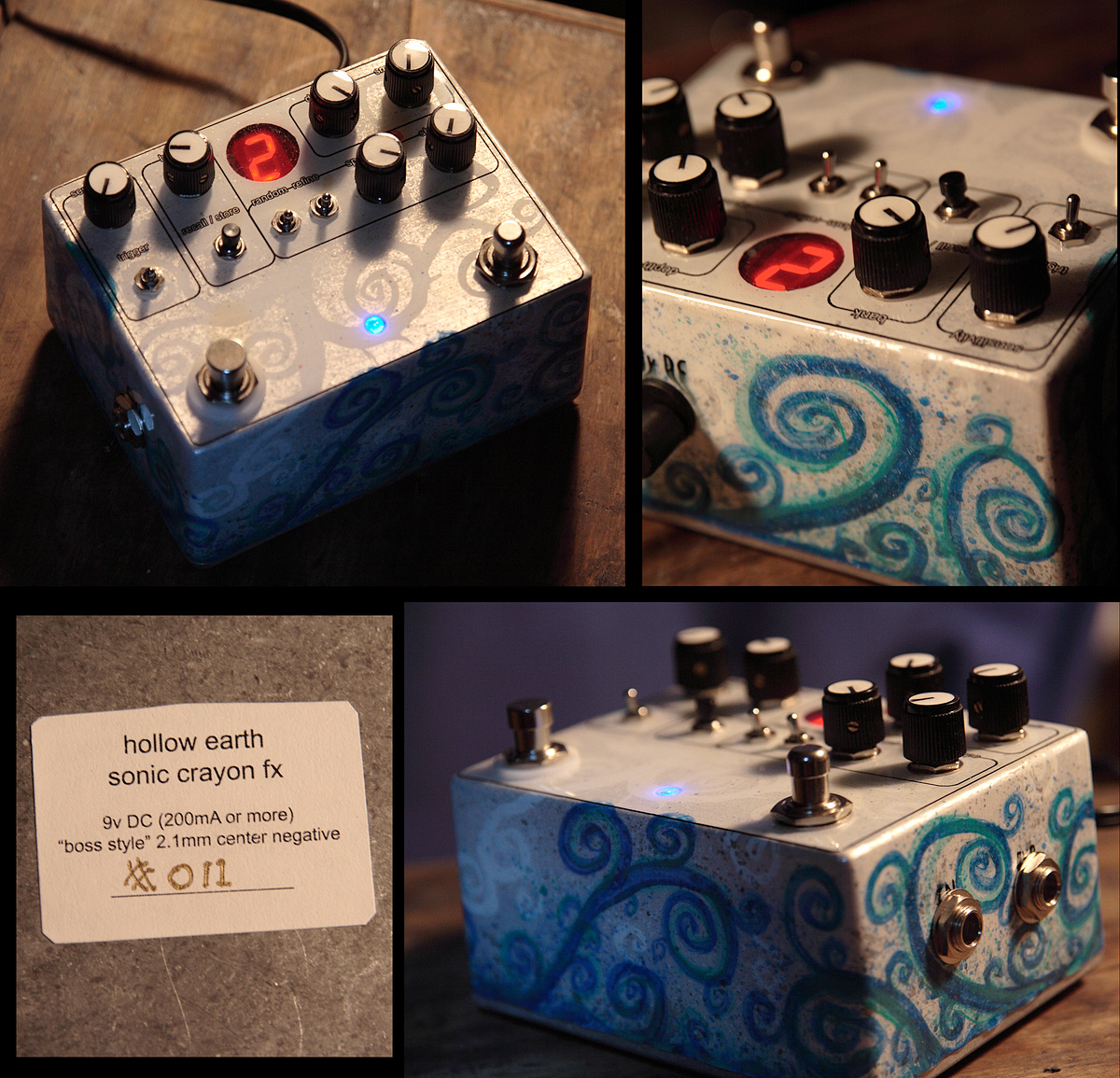
I'm building a custom-painted Hollow Earth that I'll be putting on ebay soonish. Hopefully before the end of the week. It's functionally no different from the vanilla ones, but it'll be pretty with swirlies and specks on it. See it as an experiment, testing the auction waters on a custom item.
Got this graphic LCD from MC Shop, the DX-160. Wedged it inside a bare-bones Hollow Earth with a basic UI to see the potential!
Maybe I'll build a simple synth/drone box with manually drawable waveforms too.
I'm also clocking the AVR chip a lot fastern ow, 20MHz. I could get it to update the screen a lot faster, but I don't want it to drain juice needed for other stuff.
I'm trying to squeeze the most out of this design. I've had a few feature requests and a lot of them were tap-tempo. Harmony-Central user crxsh had a good idea about making the soft-stomp, the one used for recording of shapes, multi-function. Specifically, being able to toggle it between record, tap-tempo and bank select.
I'm gonna see how feasable this is. It won't be ready for the next few batches as I still have PCBs to use up. Testing and optimizations also take time. But hopefully I'll get those to work. A three-way toggle switch could be placed on the side of the box next to the soft-stomp with a label describing the three states.
Another issue the Hollow Earth seems to have is that expression-out doesn't work with every pedal with expression-in, only some of them! I never intended it to be a main feature, just as a fun extra, but it seems more people want to use it than I had previously thought. I'll try and put some effort into increasing the compatibility of exp-out.
For the geeks, an expression pedal is basically a potentiometer. Potentiometers have three lugs, one for the minimum range, the max range, and the wiper. The way the Hollow Earth outputs expression control is by controlling an LED-LDR combo (an electrically-controlled pot), which due to its nature is the equivalent of an only 2-lug pot. While this works with many pedals with an expression-in jack, it doesn't work with those expecting 3-full lugs. So far, this includes the Eventide Timefactor and EHX HOG. I'll do my best to fix this in a later revision.
Here's a vibrato I built semi-recently. It's based on a PT2399 delay chip and I use an AVR micro with a few wavetables to generate LFO shapes.
An update on the Hollow Earth. As explained in a mass email, I'm moving to a waitlist scheme. So I've asked everyone on the notification list to email me again, and I will use that order. I've already been in contact with the four for the next batch (very soon). In the meantime, here's a video demo by user crxshdxmmy showing some examples of traditional trem and some pattern variations: